What Is AFM? A Straight Answer for GM V8 Owners
What is AFM? In one sentence, AFM is a General Motors' system to shut down half your V8's cylinders during cruising to reduce fuel consumption. In fact, this abbreviation stands for ‘Active Fuel Management’.
That is the short answer. However, a more detailed explanation is also important because AFM is also the single most discussed reliability topic among GM truck owners. It just takes you a few more minutes to understand the reason. In this article, we will introduce what the system does, which vehicles are equipped with it, why so many owners want to turn it off, and what your options are.
What Is AFM in Practical Terms?
For example, if our engine has eight cylinders, but when cruising at 65 miles per hour on a flat highway, it does not require the full power that eight cylinders can provide. At this time, you may just need a third of power what the engine can produce. Therefore, the rest of the capacity is simply carried along as dead weight.
AFM exactly takes advantage of that. When the computer detects light-load conditions, it will shut down four of the eight cylinders which are usually numbers 1, 4, 6 and 7. In other words, fuel injection to those cylinders is cut off and their valves stay closed. Then the engine runs as a V4 mode until you need more power.
The transition is designed to be nearly imperceptible. Most drivers do not notice the process at all. But some of them have reported a faint change in engine note or a slightly different feel at steady throttle.
What Is AFM Trying to Achieve?
Its purpose is simply to improve fuel economy, and nothing else. AFM is not a performance feature, an emissions device or a durability measure. It exists because a smaller displacement engine burns less fuel at light load. Therefore, by switching cylinders off, a large engine can also achieve the fuel efficiency of smaller ones without giving up the large engine when you need it.
Which GM Engines Have AFM?
AFM technology is widely used in the GM V8 range, which is why the question attracts so much attention.
On the truck side, the 5.3L V8 in the Silverado 1500 and Sierra 1500 is the most widely used powertrain configuration, which runs from about the 2007 model year through 2018. Moreover, the 6.2L V8 in high-end models is equipped with it too.
In terms of SUV models, the Tahoe, Suburban, Yukon, Yukon XL and Escalade share those engines for the same model year.
Not all models with a GM V8 badge are equipped with it. In fact, many heavy-duty applications with the 6.0L, most fleet-oriented configurations, and diesel engines do not use cylinder deactivation at all. The most reliable way is to check the RPO code sticker in your glove box, which lists the vehicle's specific factory configuration.
AFM Versus DFM: The 2019 Change
If your truck is a 2019 or newer model, it is usually not equipped with the AFM system. Instead, it features DFM (Dynamic Fuel Management) system which arrived with the L84 5.3L and L87 6.2L engines.
In fact, DFM does the same job with more sophistication. It is no longer limited to a simple eight-or-four switch. Instead, it can run seventeen different firing patterns and keep adjusting which cylinders fire and how many. The result is finer control and, in principle, economic efficiency.
This distinction is really important if you plan to purchase for a disable module. A device which is designed for AFM's binary logic may be fully ineffective on on a DFM engine. Therefore, you should check in advance which system your specific year and engine uses.
Why Do Owners Want AFM Turned Off?
This is almost a problem with the valve lifters.
In order to deactivate a cylinder, AFM uses special lifters that can collapse internally. Oil pressure, directed by a valve lifter oil manifold, pushes locking pins out of engagement so that the lifter telescopes instead of opening the valve. When the system returns to eight-cylinder mode, the pins must re-engage smoothly.
If a pin fails to re-lock correctly, the lifter will stop following the movement of the camshaft lobe. That will accelerate wear on both parts. And if a camshaft lobe is damaged, it will be more complex a larger job to replace a lifter. GM V8 owner forums are full of these cases. Although many engines run past 200,000 miles without trouble, the failure mode is well documented enough that many owners choose to avoid the cycling altogether.
There is also a small group of people who dislike AFM due to the driving experience, such as the transitions, the way the transmission behaves at light throttle, or simply preferring the engine to run in eight-cylinder mode.
What Is AFM Costing You If You Disable It?
Fuel is a trade-off to consider. Owners who have installed a disabler often report a decrease of about one to two MPG on the highway. However, during city driving, there is much less difference because AFM engages rarely anyway. As for towing, there is almost no change. Therefore, whether it is worthwhile depends on how you weigh a small ongoing fuel cost against a high potential repair expenses.
How Do You Turn AFM Off?
There are three methods, which are listed in ascending order of cost and permanence.
You just need to plug a plug-in module into the OBD-II port under the dashboard. In this way, you can prevent the computer from ever meeting the conditions it needs to deactivate cylinders. Moreover, this method is cheap, you can remove it in seconds and will not change the factory calibration.
A custom tune rewrites the engine calibration so that deactivation is removed from the software fully. It is more expensive. Unless the software is reflashed, the settings remain permanently in effect and a dealer can detect it.
If you fully delete AFM or DOD system, it is a mechanical modification. In details, the camshaft is replaced with a non-AFM design, standard lifters are installed, the lifter oil manifold is blocked off, and a tune accompanies it. This method removes the hardware rather than preventing it from operating, so the costs will run as high as several thousand dollars..
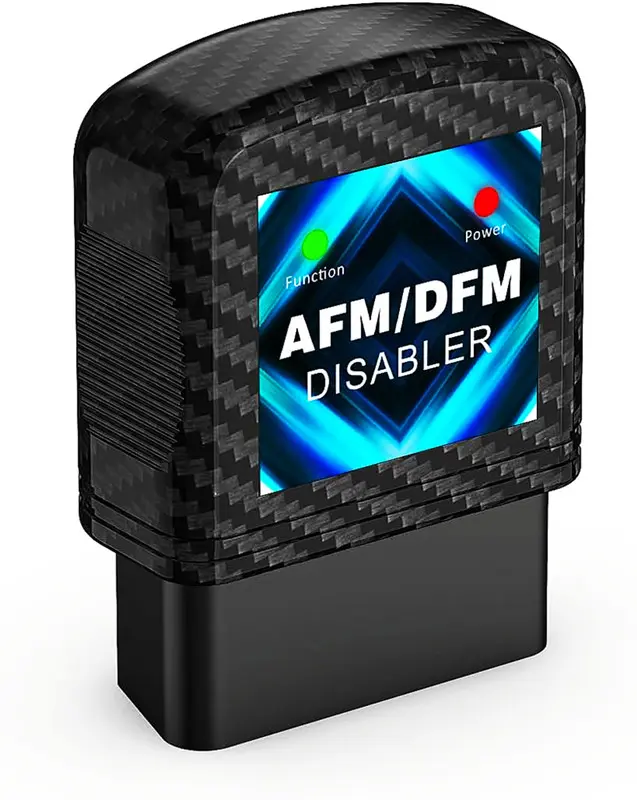
The cheapest reversible route
Ropode AFM DFM Disabler — 5.3L Daily Driver Pick
The plug-in option described above: goes into the OBD-II port, keeps the engine on eight cylinders, and unplugs in seconds with nothing left behind. Confirm your model year before ordering.
Buy on AmazonWe may earn commission from links in this article, at no extra cost to you.
Should You Do Anything About It?
There are good reasons for not changing it. The AFM was designed by GM and has been used in millions of vehicles, and many of them never have a problem. If your truck is properly maintained on short oil change intervals with correct-specification oil and has never made a noise, it is reasonable to doing nothing.
There is also a reasonable case for installing a module. It is inexpensive, takes only a minute to install, and is completely reversible. What’s more, you can remove one variable from a known failure mode.
However, it is not reasonable to install a disabler in the hope of fixing something. If your engine already ticks, misfires or runs rough, that is a mechanical problem which needs immediate diagnosis, and no module will solve it.
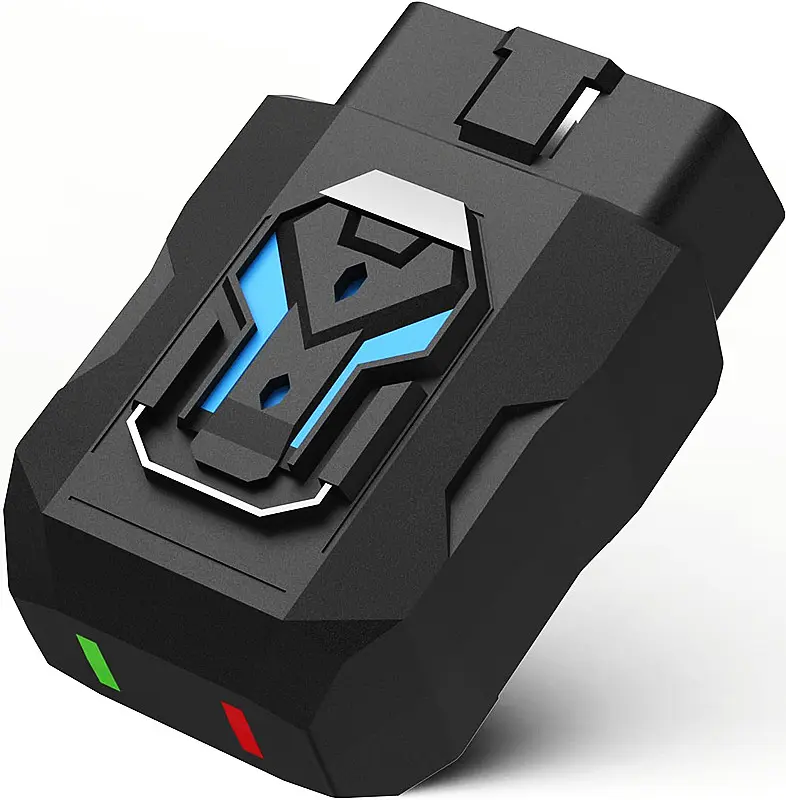
If you drive short trips
Ropode AFM Disabler — Auto Re-Arm Option
Same job, but it re-arms on its own at every start instead of needing a button press — the feature that decides most owners' long-term satisfaction.
Buy on AmazonFrequently Asked Questions
What is AFM in a car?
AFM stands for Active Fuel Management, a General Motors' cylinder deactivation system. It shuts down four of eight cylinders during light-load cruising to save fuel, then brings them back when you accelerate.
Is AFM bad for your engine?
The system itself is not harmful, but the collapsible lifters it relies on are associated with a well-documented failure mode. Many engines never have trouble, but some do encounter problems that a preventive industry has emerged around it.
Can you tell when AFM is active?
Some vehicles display a fuel-mode indicator on the dashboard. In addition, another reliable method is a scan tool. You can use it to observe the cylinder-mode parameter switching between V8 and V4.